Active recall: how to write flashcards that actually work
Rereading feels productive but isn't. Here's how active recall works, and eight rules for writing flashcards that test you instead of fooling you.
Spaced repetition
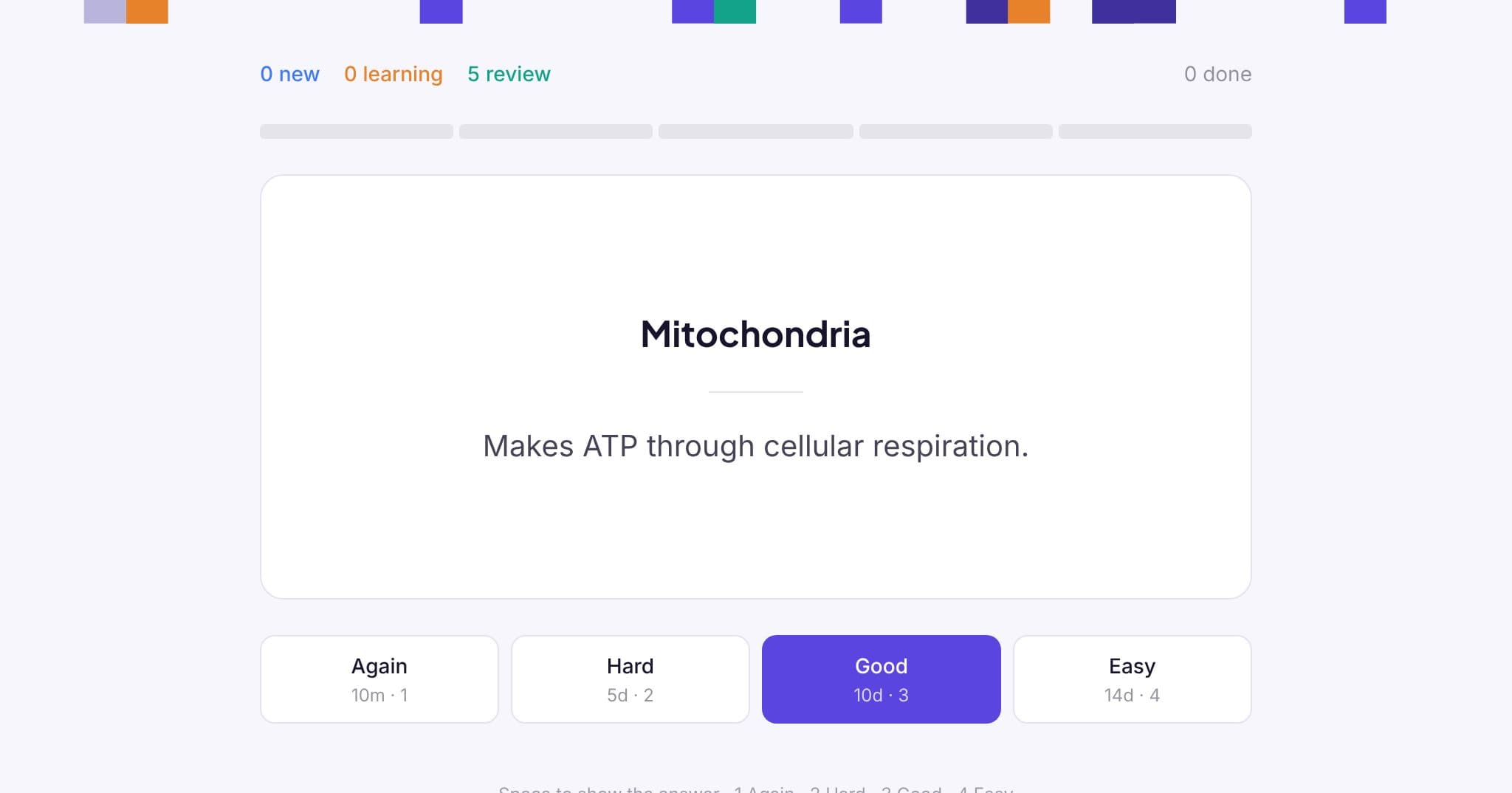
Spaced repetition
The same proven scheduling idea Anki uses: each card's gap grows every time you remember it.
Grade each card Again, Hard, Good or Easy. Every button shows when you'd see the card next.
Quiz questions schedule on their own: a right answer counts as Good, a wrong one as Again.
Up to 20 new cards a day per set, so a big deck doesn't bury you on day one.
Your dashboard and every set show what's due today and how well you know it.
Fix a typo or add cards without losing the history of the cards you already know.
How it works
StudyPix lines up today's due cards plus a few new ones.
Try to recall the answer, flip, and grade how it went.
Each card returns on the day it's due. A few minutes a day is enough.
From the blog
Rereading feels productive but isn't. Here's how active recall works, and eight rules for writing flashcards that test you instead of fooling you.
Why you forget, how spaced repetition fights the forgetting curve, how the SM-2 algorithm schedules reviews, and how to build a daily habit that lasts.
What research says about learning games and gamification, why retrieval is the part that matters, and how to play study games so they count as studying.
FAQ
A study method where you review material at growing intervals: a day, then a few days, then a week or more, timed to just before you'd forget it.
New cards go through short steps (1 and 10 minutes), then 1 day. After that the gap grows by the card's ease: with Good each time that's about 1, 3, 8 and 20 days.
Nothing breaks. Overdue cards wait in your queue, oldest first.
Works well with
Sign up with Google or your email and you're studying in under a minute. No card, no trial.