Do study games actually help you learn?
What research says about learning games and gamification, why retrieval is the part that matters, and how to play study games so they count as studying.
Study games
Study games
Pair every term with its definition against the clock. Wrong pairs add a second.
60 seconds of rapid-fire questions. Streaks multiply your points up to ×4.
Answers fall down four lanes. Hit the right one before it lands. Three lives.
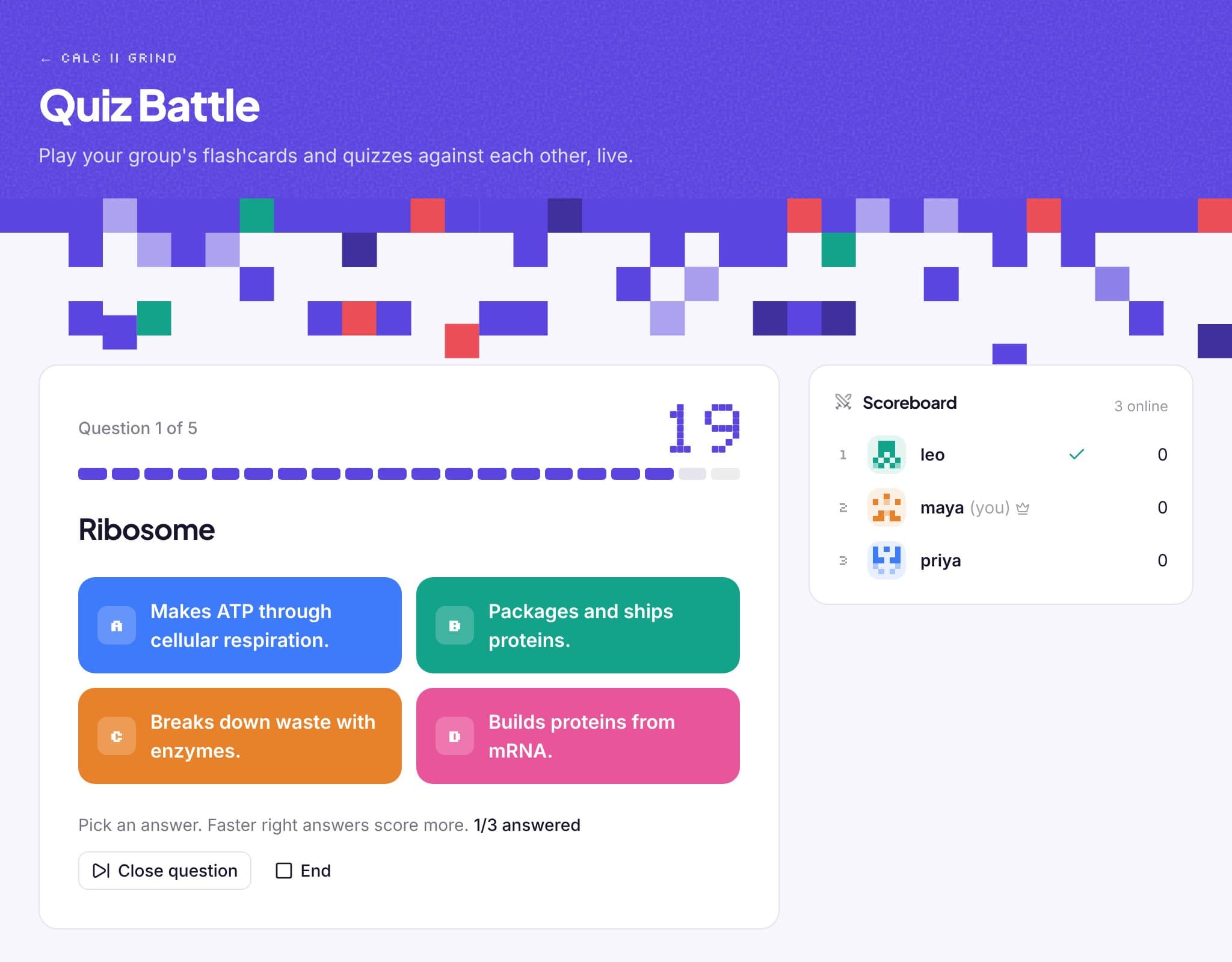
Everyone in your group gets the same question at the same moment. Faster right answers score more, up to 1000 points.
Every game ends with the questions you got wrong, next to the right answers.
Your personal best and a top-5 leaderboard for every set and game.
How it works
Choose a solo game, or open a Quiz Battle for your group.
Any flashcard deck or quiz you made or that's shared with you.
See your score and the answers you missed, then play again.
From the blog
What research says about learning games and gamification, why retrieval is the part that matters, and how to play study games so they count as studying.
Most study groups fade after week three. Here's how to pick the right size, set a rhythm, split the work and keep sessions worth turning up for.
AI can draft a deck from your notes in seconds. Here's how to get good cards out of it, what to check before you study them, and when to write your own.
FAQ
Games that make you recall answers are a form of retrieval practice, one of the best-supported study methods. The review of your misses matters as much as the score.
The host picks a set, how many questions (5 to 20) and the time per question (10 to 30 seconds). Everyone answers at once, and there's a podium at the end.
No. Flashcard decks work too: the other cards' answers become the wrong choices.
Works well with
Sign up with Google or your email and you're studying in under a minute. No card, no trial.